Thermal imaging
Electrical faults get hot before they fail. An infrared survey of your switchboards and plant finds them while they're still just a warm spot, without switching anything off.
Switchboards. Motor control. Inverters. Plant.
What a survey finds
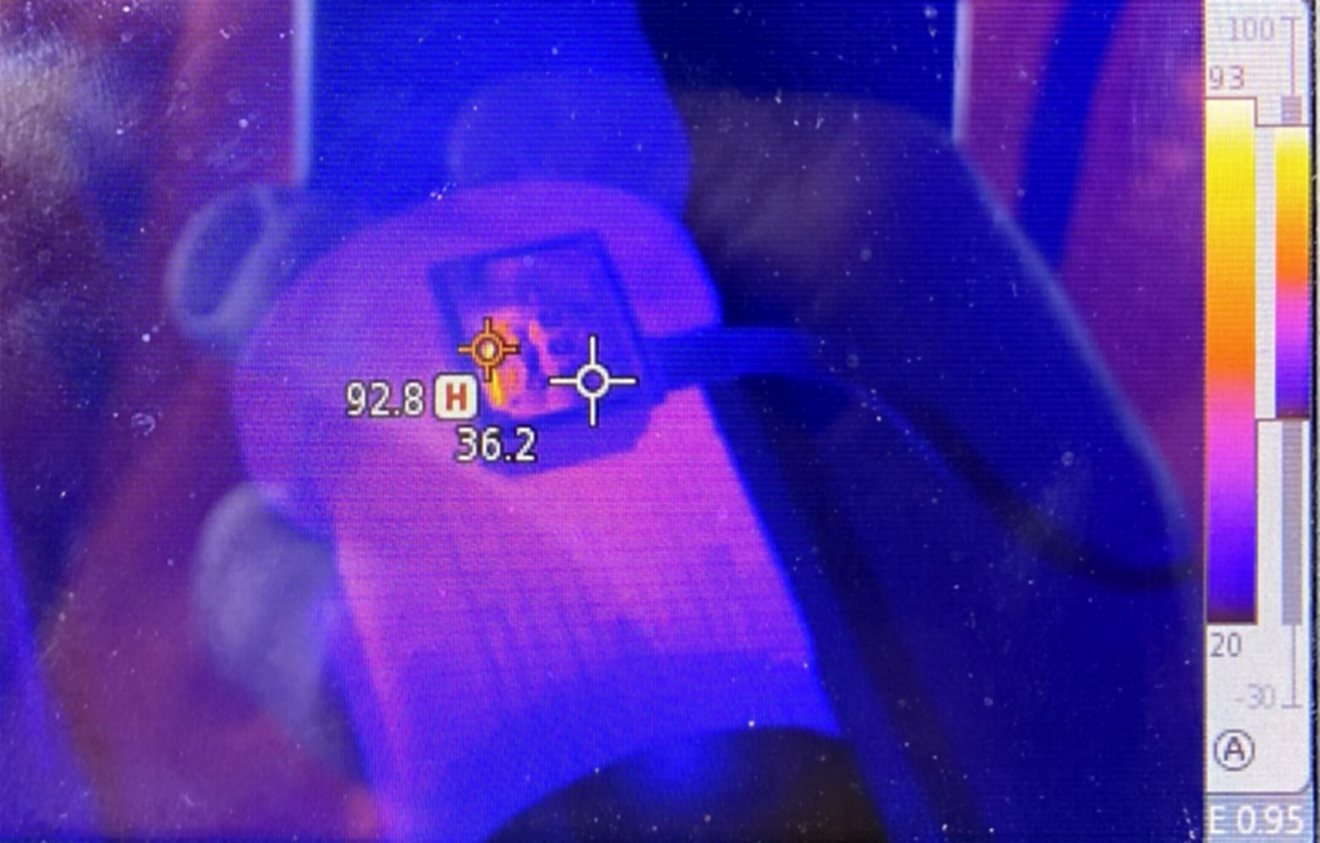
The photo above is real: one component at 92.8°C, everything beside it at 36°C. Nobody could see it. The camera could.
Almost every switchboard failure starts as a high-resistance joint. A terminal loosens over years of thermal cycling, resistance rises, the joint heats, the insulation cooks, and eventually it arcs. A thermographic survey catches that sequence at step two, when the fix is a spanner rather than a new board and a week of downtime.
- Loose, corroded or under-torqued terminations and busbar joints
- Overloaded circuits, cables and neutral conductors
- Unbalanced three-phase loads
- Circuit breakers, contactors and fuse holders running hot
- Motors, transformers, variable speed drives and control gear
- Solar inverters, DC isolators and string connections

How we do it
Live, under load, by licensed electricians working to our energised-work procedures.
Thermal imaging only works when the board is doing its normal job, so we scan during operating hours with covers off and everything running. The board is opened under our energised-work authorisation and arc flash PPE, scanned methodically bus by bus and breaker by breaker, photographed, and closed up. On most sites nobody notices we were there.
- Scanned under normal load, no shutdown needed
- Client authorisation and energised-work procedure for every open board
- Each thermal image paired with a normal photo of the same view
- Temperature rise measured against adjacent phases or components
- Every board recorded, including the ones with nothing wrong

What you get
A report you can hand to your insurer, your auditor or your own electrician.
Findings by priority
Each hot spot is rated by its temperature rise: monitor, repair at next service, repair soon, or repair now. So you know what to do this week and what can wait.
Images and measurements
Thermal and visual photos side by side, the measured temperature and the rise above reference, and the load at the time of the scan.
Recommendations and pricing
What we think caused each finding and what fixing it involves. Where you want us to, we quote the repair in the same report.
History
Repeat surveys are compared with the last one, so a joint that's slowly getting warmer is caught even before it reaches a repair threshold.
Certificate of Electrical Safety
For any repair work done as a result, as required in Victoria.
Thermal imaging questions
How thermographic surveys work and what you get from one.
What is electrical thermal imaging?
A survey of your switchboards and electrical plant with an infrared camera while they are live and under normal load. Electrical faults such as loose connections, corroded terminals and overloaded conductors generate heat before they fail, and the camera shows that heat as a temperature difference against the parts around it. It's non-contact and needs no shutdown.
What does it find?
Loose, corroded or under-torqued connections, overloaded circuits and cables, unbalanced three-phase loads, failing circuit breakers and contactors, hot fuse holders, and faults in motors, transformers, inverters and DC isolators. The photo on this page is a real example: one component at 92.8°C with everything around it at 36°C. Left alone, that connection fails or starts a fire.
Does my insurer require thermal imaging?
Many commercial and industrial insurers ask for an annual thermographic survey of switchboards as a condition of cover, or offer better terms if one is done. Check your policy or ask your broker; our report is written in the format insurers expect, with each finding rated by severity.
Does the power need to be off?
No, and it shouldn't be. Faults only show up under load, so the survey is done with the board live and running normally. Our electricians open the board under our energised-work procedures, with arc flash PPE and a client authorisation in place, then close it up when the scan is done.
What's in the report?
For every board, a thermal image paired with a normal photo of the same view, the measured temperature and the rise above the surrounding components or the other phases, a priority rating for each hot spot, and what we recommend. Boards with no findings are recorded too, so you have evidence they were checked. Repeat surveys are compared against the previous one.
How often should it be done?
Annually for most commercial sites, which also matches what insurers usually ask for. Six-monthly for heavily loaded boards, critical plant, or after a survey has found faults. Any time a board has been modified or new equipment has gone in.
Can you fix what you find?
Yes. We're a Registered Electrical Contractor, not just a survey company, so the same team that finds a hot connection can quote and repair it, retest it, and issue a Certificate of Electrical Safety where required.
Book a thermal imaging survey
Tell us how many switchboards you have and whether your insurer has asked for a report. Send a photo of the main board if you can.
- Phone0421 190 617
- Emailmatt@myes.com.au
- AreaSouth-east Melbourne and the Mornington Peninsula
- Registered Electrical ContractorREC 20716
Form not loading? Open the quote request form.